Dark history: from defenestrations to 1989
Heavy themes: the Second World War, communism and political violence. Read the three hardest stops (Pinkas, Palach, Cyril and Methodius) slowly.
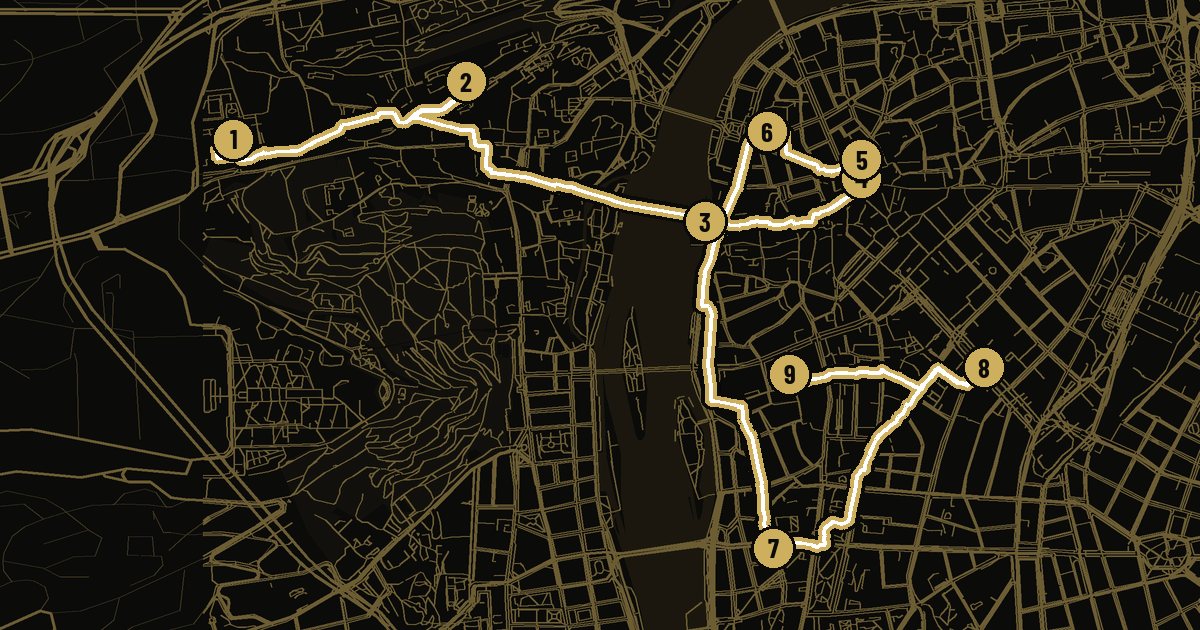
9 stops, about 115 minutes of walking, about 7.7 km. Serious subject matter.
1 Černín Palace
Hradčany and Prague Castle · Czech name: Černínský palác
Černín Palace has the longest palace front in Prague: about a hundred and fifty metres and thirty columns, in a stern baroque style. Count Humprecht Černín, an imperial ambassador to Venice, began it in the 1660s, and building it nearly ruined his family. Today it is the Czech Ministry of Foreign Affairs. In March 1948 the foreign minister Jan Masaryk was found dead below a window here, and the exact circumstances are still discussed.
2 Old Royal Palace
Hradčany and Prague Castle · Czech name: Starý královský palác
The Old Royal Palace was the home of Bohemian rulers from the tenth century. Its star is Vladislav Hall, about sixty-two metres long and thirteen high, built around 1500 by Benedikt Ried, with a vaulted ceiling and no columns. On the twenty-third of May 1618, Protestant nobles threw two royal governors and their secretary out of a window of this palace, in the Defenestration of Prague. It helped start the Thirty Years' War.
3 Old Town Bridge Tower
Charles Bridge and the River · Czech name: Staroměstská mostecká věž
The Old Town Bridge Tower is among the most beautiful Gothic gates in Europe. Charles the Fourth meant it as a triumphal arch, the start of the coronation route. Building began soon after 1357, and it was finished in the 1370s and 1380s, with rich sculpture by the workshop of Peter Parler. In 1621 the heads of twelve of the executed Czech lords were displayed from its gallery. The Swedes damaged it in 1648. You can climb it for a view.
4 Old Town Square
Staré Město (Old Town) · Czech name: Staroměstské náměstí
Old Town Square has been the market and stage of Prague history for a thousand years. The Gothic towers belong to the Týn Church, and on the Old Town Hall is the astronomical clock. On the twenty-first of June 1621, twenty-seven Czech lords were executed here after the defeat of the Protestant uprising, and crosses in the pavement mark the spot. The big monument in the centre is of the reformer Jan Hus, unveiled in 1915.
5 Kinský Palace
Staré Město (Old Town) · Czech name: Palác Kinských
The Kinský Palace is a pink and white rococo palace built between 1755 and 1765. The Kinský family bought it in 1768. Bertha von Suttner, who won the Nobel Peace Prize, was born here in 1843, and Franz Kafka went to school in this building and his father had a shop on the ground floor. On the balcony in February 1948 the communist leader Klement Gottwald addressed the crowd. Today it belongs to the National Gallery.
6 Pinkas Synagogue
Josefov (Jewish Quarter) · Czech name: Pinkasova synagoga
The Pinkas Synagogue was built in 1535 and is now a memorial to the Jewish victims of the Shoah from Bohemia and Moravia. The walls carry the handwritten names of 77,297 people, with their dates of birth and of deportation. The painters Václav Boštík and Jiří John wrote them in the 1950s. Upstairs is an exhibition of drawings by children from the Terezín ghetto. Please be quiet and respectful here.
7 Church of Saint Cyril and Saint Methodius & the Crypt
Nové Město (New Town)
This baroque church from 1730 to 1736 is now an Orthodox cathedral. In 1942, seven Czechoslovak paratroopers who had taken part in the assassination of Reinhard Heydrich hid in the crypt, and on the eighteenth of June they died after a long fight with the SS. The bullet holes are still visible in the wall at pavement level. In 1995 the church was declared a national memorial. The crypt is free, and visitors are asked to keep quiet.
8 Wenceslas Square
Nové Město (New Town) · Czech name: Václavské náměstí
Wenceslas Square is a boulevard, 750 metres long and 60 wide, founded in 1348 as the Horse Market of Charles the Fourth's New Town. The National Museum closes its upper end, with the statue of Saint Wenceslas in front. Here Czechoslovak independence was celebrated in 1918, Soviet tanks arrived in 1968, and in January 1969 the student Jan Palach set himself on fire. In November 1989 about three hundred thousand people gathered here, jingling keys.
9 Národní třída & the 17 November Memorial
Nové Město (New Town)
Under the arcade here a small bronze relief of raised hands marks the place where, on the seventeenth of November 1989, police stopped a student march and beat the demonstrators. The march had been held to remember the closing of the Czech universities by the Nazis exactly fifty years earlier. The events of that evening started the Velvet Revolution, and within weeks the communist government resigned. Candles and flowers are usually left here.
Walk this route with Prago
Prago is an audio guide to Prague for iPhone. The map is on the phone, so it works with no signal and no roaming bill, and it starts talking when you walk up to a place. There is no account and no tracking. Coming soon to the App Store.
More walks
- Prague highlights in 2 hours 8 stops
- The Royal Way: Powder Tower to the Castle 9 stops
- Quiet Malá Strana 5 stops
- Castle Hill, top to bottom 7 stops