Clementinum
Staré Město (Old Town) · Czech name: Klementinum
The Clementinum is the second largest complex of buildings in Prague after the castle. It began as a Dominican monastery, and in 1556 the Jesuits arrived and made it a college. It was built over more than a hundred and seventy years and now houses the National Library. It has a baroque library hall, a Mirror Chapel and an astronomical tower, where weather has been recorded since 1775, the longest continuous series in Central Europe.
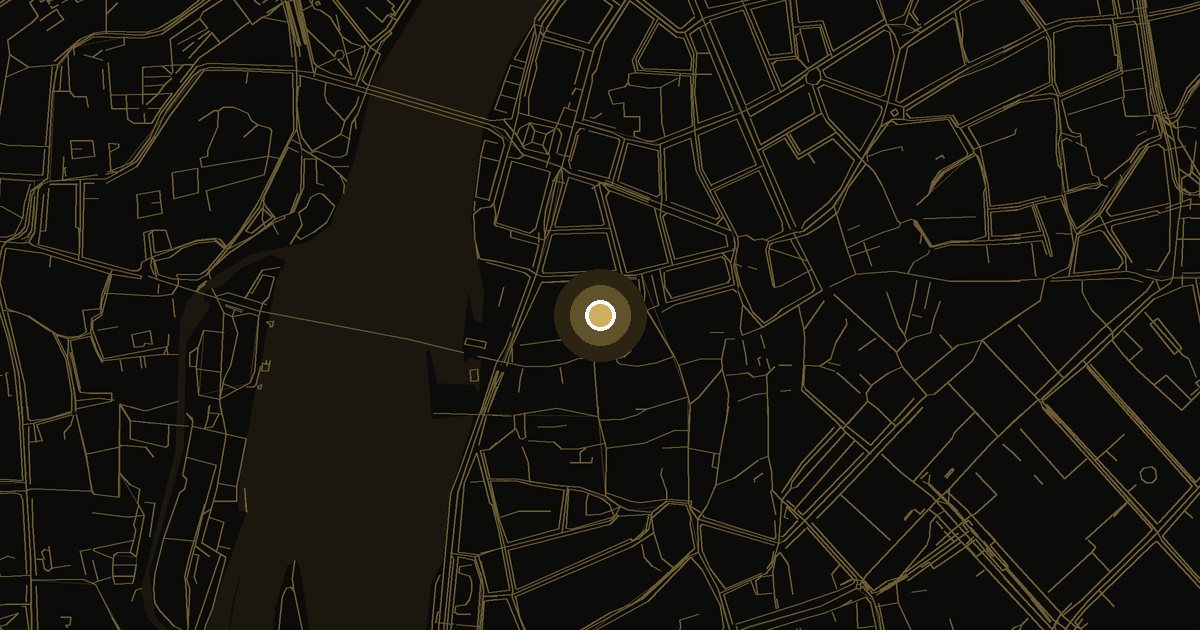
What you see
An enormous complex of courtyards, nearly two hectares, walled off from the street. Inside: an astronomical tower, a chapel of mirrors, and a baroque library hall with ceiling frescoes and globes on the floor.
The story
After Prague Castle, the Clementinum is the second largest complex of buildings in Prague, covering about two hectares around five courtyards, with two churches and two chapels. It is named after Saint Clement, and it began as a Dominican monastery. The Dominicans moved here from another church of the same name around 1227, and the monastery grew into one of the largest and most important in Bohemia, with a school that later became part of Charles University.
In its long refectory, about thirty-seven by ten metres, the city council met, courts sat and important political talks were held. In 1359 Charles the Fourth took part in a general chapter of the Dominican order here, and in 1409 Jan Hus, then rector of the university, preached at Saint Clement's. The Dominicans also ran an inquisition court, and they were unpopular, so when the Hussite wars began, the monastery was burned on the eighth of August 1420 and the monks who did not escape were killed.
It never recovered, and the collapse of the church tower in 1467 finished it. In 1556 the Jesuits arrived. The future archbishop of Prague and Emperor Ferdinand the First had both asked Ignatius of Loyola for Jesuits in Bohemia, and the first twelve came from Rome on the twenty-first of April 1556 and settled in the ruined monastery, which the king gave them as a gift.
Teaching began on the seventh of July 1556, and in 1616 their school was raised to a university, to rival the Protestant Charles University. After the Battle of White Mountain in 1620 the Jesuits were put in charge of Charles University too, and in 1622 they moved its library here. They also bought or received thirty-two neighbouring houses, seven courtyards and two gardens, and after the Thirty Years' War they built on a large scale.
The first large phase, from 1653, was early baroque and led by Carlo Lurago. It was in this period that the Clementinum got the first flush sewer system in Prague. The main period was 1709 to 1726, which completed the complex in the high baroque, so the whole took over a hundred and seventy years.
Two interiors are the reason for most visits. The baroque library hall sits above the Mirror Chapel and was designed as a library from the start. It has two levels with a gallery, shelves between gilded columns, some plain and some twisted, and a ceiling painted by Jan Hiebel, the first library in Bohemia with a vault covered with frescoes.
The main fresco shows a Temple of Wisdom with an illusionistic dome. Historic globes from the Clementinum collection stand in the hall. The Mirror Chapel next to it, from 1722 to 1724, is a small space of mirrors, gilding and stucco, famous for its concerts.
And the Astronomical Tower is topped by a statue of Atlas carrying the celestial sphere, made in the workshop of Matthias Bernard Braun. The tower has been used for astronomical and weather observations, and the weather has been recorded here systematically since 1775, which is the longest continuous series of observations in Central Europe. After the Jesuit order was dissolved in 1773, the Clementinum was taken over by the university, and in 1777 Empress Maria Theresa declared the library a public one.
The complex has also been a seminary, the first home of the Academy of Fine Arts, and a picture gallery from which the later National Gallery grew. In 1791 an industrial exhibition for the coronation of Leopold the Second was held here. In 1923 the state decided that the whole area should serve the library, and after reconstruction in the 1920s and 1930s, it became the home of what has been, since 1990, the National Library of the Czech Republic.
Under the legal-deposit law, it collects everything published in the country. The library holds a collection of Mozartiana, and material on Tycho Brahe and Comenius, and in 2005 the library received the UNESCO Jikji Prize, from the Memory of the World programme, for its work digitising old texts. Students have also fought from here.
In 1648, when the Swedes attacked Charles Bridge, a student legion led by the Jesuit father Jiří Plachý helped hold them off, and a statue of a student in the first courtyard recalls it. In the revolution of 1848 the students barricaded themselves inside the Clementinum and even took prisoner the governor of Bohemia, Count Leo Thun, releasing him only when the historians Palacký and Šafařík urged them to. The writer Jorge Luis Borges put the Clementinum into a short story, The Secret Miracle, where a dreamer finds God in a single letter in one of the library's books.
Hear it on the spot
In Prago this story plays when you walk up to Clementinum. The map is on the phone, so it works with no signal, and there is no account and no tracking. Coming soon to the App Store.